A person with Tourette’s.
Touretter.
Ticcer.
Tourette’s sufferer.
Twitch.
In my email this week was the weekly update from a Tourette’s forum I frequent (but don’t post on) and in the weekly update was a post about whether the term Touretter is offensive. And it really made me think. And then I read the post, and I was reminded why I don’t post on Tourette Syndrome forums.
Touretter.
I use this word a lot, to describe myself and what I live with. In my mind it does a decent job – I am a person with Tourette’s. A Touretter. Why would I find that offensive? I prefer the term Touretter much more than I do Tourette’s sufferer. Or Twitch. Ugh. Of course my Tourette’s makes me “suffer”, it’s a medical condition from which there is no end. Everyday I wake up and “suffer” from my condition, but that isn’t to say I am a Tourette’s sufferer. That implies to me that there is nothing I can do about it, that I am doomed to forever suffer because of my disability.
Some people were explaining that saying “Touretter” is putting the disability first. This is a concept we talk about all the time in the special education world; about not labeling the child. You say “a child with autism” instead of “autistic child”. You put the student first before their disability – to remind people that a person with a disability is still a person, their disability shouldn’t define who they are.
But isn’t that what Tourette’s does to a person? I am infinitely stronger than I would have been if I had never lived with Tourette’s. There are very few people in the world who can (honestly) say that they can walk into a crowded room and not give a whit what anybody there thinks of them, good bad or otherwise. Of course, I care what my friends and family think. But if I ran into you on the street and you wanted to stare blatantly or make rude, asinine comments, be my guest! I can’t promise that what you say and do wouldn’t be put up on my blog, but it really doesn’t bother me. The only reason I control tics out in public is to not harm myself; it isn’t because I might annoy somebody. Of course, there is a slight aspect of not getting thrown out of somewhere, but that is minimal compared to the prospect of pain. If ticcing caused me no pain, I would tic my heart out in public. It wouldn’t matter.
I am more empathetic about what other people may be living with in their lives; you can’t tell by looking at me I have a disability or am in chronic pain. So why should I judge anybody else based on external features? I am a better teacher for what I live with and I now I am better equipped to teach in the special education world because I “get” what it is like to be disabled in a non-disabled world.
And having Tourette’s really really lets you know who your “true” friends are. Trust me, it takes a true friend to be able to sit next to you at a restaurant when you continually throw your fork on the ground or head bang so badly that you can’t feed yourself, making the meal last twice as long. A good friend laughs when you tic into them and hit them, instead of getting up and moving away. In fact, I have friends who sit next to me in crowded places knowing they are in the “tic zone” so that I don’t have to worry about what I do. And these are the same friends who will laughingly contradict me when I tell them I didn’t tic because I was unaware of what I was doing.
And these are also the same friends who kick me out of work – and I do mean kick me out despite all my best protests – and would cover me so I could take a break when I needed it. (You know who you are). :)
My Tourette’s doesn’t dictate my life, it doesn’t run my life, and it doesn’t have any bearing on my hopes and dreams. But it does define who I am. I am not the same person today that I could have been if I had been neurotypical. And that’s okay with me; I like the person I am. I wouldn’t trade being neurotypical for being a good teacher or for being ashamed of who I am and worrying about what people think. So yes, I am a Touretter, and that’s okay with me.
The funny thing about the word Touretter though, is it is a word that only people with Tourette’s use. Tourette Syndrome is so grossly misrepresented and unheard of that if I call myself a “Touretter” out in public, odds are that nobody around me even knows what I’m talking about. Which leads me to why I don’t go to Tourette Syndrome forums.
When I was first diagnosed of course I went on the internet. In fact, I had done so much internet research I had diagnosed myself with Tourette Syndrome before I was in the neurologist’s office that first time. I knew I was experiencing tics, and it wasn’t a big reach to get to Tourette’s from there. The next logical step for me was to seek out forums where other Touretter’s were (this was before facebook got really big). I wanted to be able to talk with people who had survived this, people who were able to have jobs and relationships in spite of their Tourette’s. So I looked for support groups online. I didn’t even find any United States-based forums. I joined the Tourette Syndrome Foundation of Canada. Where I then discovered that there were virtually no adults with Tourette Syndrome there.
Oh, there were adults all right. But they didn’t have Tourette’s, they had children with Tourette’s. And they were using the forum to console each other on the hardship that had befallen their family. I get that Tourette’s sucks. It sucks to be diagnosed with and I can only imagine how it would feel to have a child diagnosed with Tourette’s. In my opinion though, it doesn’t help anybody to sit and post and wallow in self-pity. If you are a parent of a child with Tourette’s, let me explain something to you. Your child is the one with Tourette’s. It is their life; they are the ones who will be made fun of in school and who will have to deal with people staring at them. And I hope and pray that everyone in that situation is one of those lucky few who “grow out of it”. But that is something that doctors tell parents to make them feel better; the truth is that most individuals with Tourete’s get better at controlling it as they get older, but that they don't "grow out of it".
And I’m certainly not upset with those parents who are trying to actively find ways to help their children. More power to them. I’m talking about the ones who want to commiserate with each other about this horrible thing that has happened to their family and how will they ever deal with it? Newsflash. You don’t. Your child deals with it and it is your job to help them do that.
I couldn’t stand being one of the oldest people on the forum at 15-years-old so I hardly ever even visit and I never post. At 21 now, I would be sure to be among the oldest, and at 21-years-old I am a parent’s worst nightmare. I am the child who never “grew out of it”, so why would they want anything to do with me? I am a constant reminder of what it could be like for their children. Forget the fact that I am successful; that I am going to graduate with honors in less than 3 months; that I am able to hold down two part-time jobs while going to school full time. I am disabled. To the point of needing a service dog to help mitigate the symptoms. I will never "grow out of it". This is what the rest of my life is going to be like; fighting for the right to have a job or to go somewhere, fighting for acceptance in a workplace and relationships, and fighting to have people see past a neurological disability to see me. I am lucky that I am able to work and be successful, but it isn't by chance. I have to work hard for everything I want in life. It takes extreme physical and mental effort just to be able to sit in class. I'm not even talking about learning anything; just the act of being physically present takes extreme effort. If I want to actually learn, that takes more effort to pay attention and take notes. And if I'm having any kind of a bad day; it becomes virtually impossible to sit still, to be quiet, and to be mentally present and aware enough to pay attention. I end up re-teaching myself a lot of material outside of school and spending extra time on my weekends catching up on assignments. I made a decision a long time ago to keep my grades up and to not let my disability dictate how I do in life. But it's certainly not easy. Learning used to be something that was second nature to me and now it is something I have to expend every ounce of effort to achieve; certainly not a future anybody wishes for their child.
Thank goodness for facebook though. There is a Tourette’s support page where adults(!) with Tourette’s post and share stories and discuss medication options. I am among some of the youngest people in the group. There is a wide range of experiences in the group; from people with mild tics to people who are more severe than I am and everything in between. Not that everything that is said in the group is positive, there is still a lot of “my tics are worse than your tics” stuff that goes on. But, it is a different vibe because even when it isn’t all positive, the majority of the people talking are people who “get” it.
And now that I’ve taken – what my master teacher calls – a bird walk, back to the thought that sparked this (oh so very long) post. Touretter. The only people who even know or use the term are those who live this life. So why are parents of Touretters discussing how “offensive” they find this word. What part of it is offensive? Somebody I don’t know calling me “twitchy” or a “Tourette’s sufferer”, or people watching me waiting for me to start swearing uncontrollably, now that is offensive. Calling me by what I am doesn’t offend me. I am a person living with Tourette’s, a Touretter; if you see something offensive in that statement then you probably aren’t comfortable with the words Tourette Syndrome or disability either.

Thursday, March 1, 2012


Sunday, February 26, 2012
If pigs could fly...
If I had a dollar every time somebody asked me if I were going to be swearing in their presence, I would be a heck of a lot closer to funding my service dog. I cannot begin to count up all the times that I have had people ask me if I swear uncontrollably, or tell me how cool it is that I get to “get away” with swearing all the time. I have even had professors in the education department at my school ask if I will be swearing in their class.
The funny thing about living with Tourette’s is that it isn’t a “get out of jail free” card. I would still get the same nasty looks if I started swearing in public even if I disclosed to everybody within earshot I had Tourette’s. People really don’t care. Sure, it sounds good in theory; I disclose my disability and everybody goes on their merry way. But you can’t ignore somebody dropping the “f-bomb” at the top of their lungs in a grocery store or somebody muttering inappropriate phrases under their breath in the library. It is still socially inappropriate, even if you do choose to disclose.
Tourette’s is so much more than swearing in quiet rooms; in fact, only 10% of Touretters experience coprolalia. If approximately 1 in every 1,000 people in the United States have been diagnosed with Tourette Syndrome and only 1 in every 10 of those Touretters have coprolalia, this is only 0.01% of the population who have the “swearing tic”. Why then, do educated professors at my college ask me if I’m going to swear in class? Why is that the only way Tourette’s is ever portrayed in Hollywood movies? People tell me that I’m lucky because I can swear without retribution. They don’t know what it is like to be terrified that the “f-bomb” will be pulled out of your throat without your permission. I would never swear at somebody and blame it on my tics; the same way I wouldn’t pretend to have any other disability.
That isn’t to say I don’t swear, and that isn’t to say that I don’t swear in response to my tics. Trust me, when you slam your head into a piece of furniture so hard you see stars and get a concussion, keeping your language clean isn’t the first thing on your mind. When your toes are curling up for so long and with such force that you are stricken with wave after wave of never-ending charlie-horses, swearing really isn’t all that out of line. But I’m in control of what comes out of my mouth, even if it doesn’t feel like it at the moment, I have the control to keep my mouth shut or to swear. Coprolalia is different; when I was experiencing coprolalia, I had no control. It was like an out-of-body experience, somebody else reached in and took control of that part of my brain and made it say things. It’s like when I have palalia (repetition of syllables, words, or phrases that I say), I’m not in control of the words and sounds coming out of my mouth at that point in time. The difference is that palalia only makes me sound like I have a stutter, coprolalia makes me sounds like someone with severe boundary issues and no verbal filter.
When I was a freshman I did a speech in my speech class about how Tourette’s is portrayed by the media. I knew it was bad, but I was honestly appalled. There is a reason that Tourette's has the "image" it does; it is the only way it is portrayed. Ever. The Touched by an Angel Christmas special one year was about a father who was so upset and frustrated by his child having Tourette’s that he ended up committing murder. I just finished a book (that was published very recently) that had a character with Tourette’s - even though it was barely talked about - who was under suspicion of committing murder and who had lived alone all his life because he never found somebody to love him in spite of the tics. In fact, in looking up every instance of Tourette’s in shows and movies and books I could find, I was startled to find that the only positive portrayal of Tourette Syndrome in main-stream media was on South Park of all things. I don’t watch South Park at all, but my understanding of the episode from the clips I was able to find online is that they introduce a character with Tourette’s to the show. One of the main characters thinks how cool it must be to get away with swearing and hitting people that they start to imitate the behaviors, telling people they have Tourette’s. By the end of the episode they have explained why it is hurtful to imitate the tics and while it may look cool to be able to get away with things like that, it is still a medical disorder (I’m pretty sure they don’t call it a disability, but maybe somebody with more South Park knowledge could let me know) and not a choice.
Much more despicable than the person who has been simply misinformed, is the person that chooses to imitate Tourette's. A non-disabled, neurotypical person, choosing to imitate Tourette's to get away with something. In a previous blog post I described what it is like for me to fly, it's nothing short of an excruciating form of mental torture. You are in such close quarters to other people that the odds of having a tic that gets out of control and hits or jostles somebody increases exponentially. Somebody I used to live with knew all of this. They knew my tics, what they looked like, and the hell I went through trying to have some semblance of normalcy in my life (this was before I had become very open about what I live with). After a break from school, they described to me how on the last flight they were on, somebody sitting next to them was in their personal space and how they began to pretend to tic, snapped at the person that they had Tourettes, and then enjoyed a flight with more arm room. Truthfully, I didn't say anything to them at that moment in time; I was too taken aback to formulate an appropriate response. I'm no longer in contact with the person, but that still gets under my skin. That somebody who is neurotypical, that has a brain and body that functions they way it was meant to, thought it was okay to imitate my disability to make their lives a little easier. There is nothing easy about life with Tourette's.
Somebody once asked me if I felt like it were my "mission" to educate people on Tourette Syndrome (this was during a presentation and I feel as though they might have thought I became a little “preachy”). At the time I answered “No.” Now though, I might be tempted to answer yes, at least to some extent. I am a person with a disability. And not a run-of-the-mill, easily accepted disability, but an invisible disability that leaves me susceptible to ridicule and stereotyping just by saying the word “Tourette’s”. I have never had an access challenge, I have never had anybody try and remove me from somewhere I am, even though people might on occasion wish it. I have never had to explain myself to management or an employee, though I have heard many instances where people with Tourette’s have had to do this. I don’t think I’m incredibly lucky for never having had a run-in, or that this means I’m a “mild” Touretter; all it is, is evidence of is my ability to stay out of public when I might have particularly strong tic outbursts. I don’t go to movies late at night (and certainly not to The Artist). I would prefer being in a louder restaurant than a quiet one, because then when I do tic it’s less noticeable. I turn down invitations with friends to go out if I know that I will have had to work all day that day or I know I’m already feeling tired. I can’t and I don’t work past 6:30 at night, not because I don’t need the money, but because that has me home by 7:00. Any later and I start to doubt my ability to drive home safely. I never go to study in the library at school because I would be too worried about causing a disturbance to get any work done. I am careful. I avoid instances where I have to tell people I have Tourette Syndrome because it is so mis-understood and stereotyped against.
But, even though I am a person with a disability, I have as much right as a neurotypical person to be somewhere. And that does mean speaking out about my disability and about what I live with. That means attempting to educate people about life with Tourette’s, because maybe something I say sinks in. In my eyes there has been a lot done to perpetrate this gross misconception about what Tourette’s is, and there is still a lot being done to continue this. There was a movie preview I remember seeing this summer where a character made a joke about Tourette’s. I know some Touretters don’t really mind that, but I do. Not because I don’t have a sense of humor about what I live with (how could you not?), but because that doesn’t help people living with Tourette’s. Nobody – at least I hope nobody – makes jokes about people who are blind, or in a wheelchair. But for some reason, it is still acceptable to make jokes about people with Tourette Syndrome. And if my living a “normal” life means I have to educate people about intimate details of my life and talk about the stereotypes surrounding Tourettes, then so be it.
And don’t even get me started on the “Tourette’s Guy” youtube videos…
The funny thing about living with Tourette’s is that it isn’t a “get out of jail free” card. I would still get the same nasty looks if I started swearing in public even if I disclosed to everybody within earshot I had Tourette’s. People really don’t care. Sure, it sounds good in theory; I disclose my disability and everybody goes on their merry way. But you can’t ignore somebody dropping the “f-bomb” at the top of their lungs in a grocery store or somebody muttering inappropriate phrases under their breath in the library. It is still socially inappropriate, even if you do choose to disclose.
Tourette’s is so much more than swearing in quiet rooms; in fact, only 10% of Touretters experience coprolalia. If approximately 1 in every 1,000 people in the United States have been diagnosed with Tourette Syndrome and only 1 in every 10 of those Touretters have coprolalia, this is only 0.01% of the population who have the “swearing tic”. Why then, do educated professors at my college ask me if I’m going to swear in class? Why is that the only way Tourette’s is ever portrayed in Hollywood movies? People tell me that I’m lucky because I can swear without retribution. They don’t know what it is like to be terrified that the “f-bomb” will be pulled out of your throat without your permission. I would never swear at somebody and blame it on my tics; the same way I wouldn’t pretend to have any other disability.
That isn’t to say I don’t swear, and that isn’t to say that I don’t swear in response to my tics. Trust me, when you slam your head into a piece of furniture so hard you see stars and get a concussion, keeping your language clean isn’t the first thing on your mind. When your toes are curling up for so long and with such force that you are stricken with wave after wave of never-ending charlie-horses, swearing really isn’t all that out of line. But I’m in control of what comes out of my mouth, even if it doesn’t feel like it at the moment, I have the control to keep my mouth shut or to swear. Coprolalia is different; when I was experiencing coprolalia, I had no control. It was like an out-of-body experience, somebody else reached in and took control of that part of my brain and made it say things. It’s like when I have palalia (repetition of syllables, words, or phrases that I say), I’m not in control of the words and sounds coming out of my mouth at that point in time. The difference is that palalia only makes me sound like I have a stutter, coprolalia makes me sounds like someone with severe boundary issues and no verbal filter.
When I was a freshman I did a speech in my speech class about how Tourette’s is portrayed by the media. I knew it was bad, but I was honestly appalled. There is a reason that Tourette's has the "image" it does; it is the only way it is portrayed. Ever. The Touched by an Angel Christmas special one year was about a father who was so upset and frustrated by his child having Tourette’s that he ended up committing murder. I just finished a book (that was published very recently) that had a character with Tourette’s - even though it was barely talked about - who was under suspicion of committing murder and who had lived alone all his life because he never found somebody to love him in spite of the tics. In fact, in looking up every instance of Tourette’s in shows and movies and books I could find, I was startled to find that the only positive portrayal of Tourette Syndrome in main-stream media was on South Park of all things. I don’t watch South Park at all, but my understanding of the episode from the clips I was able to find online is that they introduce a character with Tourette’s to the show. One of the main characters thinks how cool it must be to get away with swearing and hitting people that they start to imitate the behaviors, telling people they have Tourette’s. By the end of the episode they have explained why it is hurtful to imitate the tics and while it may look cool to be able to get away with things like that, it is still a medical disorder (I’m pretty sure they don’t call it a disability, but maybe somebody with more South Park knowledge could let me know) and not a choice.
Much more despicable than the person who has been simply misinformed, is the person that chooses to imitate Tourette's. A non-disabled, neurotypical person, choosing to imitate Tourette's to get away with something. In a previous blog post I described what it is like for me to fly, it's nothing short of an excruciating form of mental torture. You are in such close quarters to other people that the odds of having a tic that gets out of control and hits or jostles somebody increases exponentially. Somebody I used to live with knew all of this. They knew my tics, what they looked like, and the hell I went through trying to have some semblance of normalcy in my life (this was before I had become very open about what I live with). After a break from school, they described to me how on the last flight they were on, somebody sitting next to them was in their personal space and how they began to pretend to tic, snapped at the person that they had Tourettes, and then enjoyed a flight with more arm room. Truthfully, I didn't say anything to them at that moment in time; I was too taken aback to formulate an appropriate response. I'm no longer in contact with the person, but that still gets under my skin. That somebody who is neurotypical, that has a brain and body that functions they way it was meant to, thought it was okay to imitate my disability to make their lives a little easier. There is nothing easy about life with Tourette's.
Somebody once asked me if I felt like it were my "mission" to educate people on Tourette Syndrome (this was during a presentation and I feel as though they might have thought I became a little “preachy”). At the time I answered “No.” Now though, I might be tempted to answer yes, at least to some extent. I am a person with a disability. And not a run-of-the-mill, easily accepted disability, but an invisible disability that leaves me susceptible to ridicule and stereotyping just by saying the word “Tourette’s”. I have never had an access challenge, I have never had anybody try and remove me from somewhere I am, even though people might on occasion wish it. I have never had to explain myself to management or an employee, though I have heard many instances where people with Tourette’s have had to do this. I don’t think I’m incredibly lucky for never having had a run-in, or that this means I’m a “mild” Touretter; all it is, is evidence of is my ability to stay out of public when I might have particularly strong tic outbursts. I don’t go to movies late at night (and certainly not to The Artist). I would prefer being in a louder restaurant than a quiet one, because then when I do tic it’s less noticeable. I turn down invitations with friends to go out if I know that I will have had to work all day that day or I know I’m already feeling tired. I can’t and I don’t work past 6:30 at night, not because I don’t need the money, but because that has me home by 7:00. Any later and I start to doubt my ability to drive home safely. I never go to study in the library at school because I would be too worried about causing a disturbance to get any work done. I am careful. I avoid instances where I have to tell people I have Tourette Syndrome because it is so mis-understood and stereotyped against.
But, even though I am a person with a disability, I have as much right as a neurotypical person to be somewhere. And that does mean speaking out about my disability and about what I live with. That means attempting to educate people about life with Tourette’s, because maybe something I say sinks in. In my eyes there has been a lot done to perpetrate this gross misconception about what Tourette’s is, and there is still a lot being done to continue this. There was a movie preview I remember seeing this summer where a character made a joke about Tourette’s. I know some Touretters don’t really mind that, but I do. Not because I don’t have a sense of humor about what I live with (how could you not?), but because that doesn’t help people living with Tourette’s. Nobody – at least I hope nobody – makes jokes about people who are blind, or in a wheelchair. But for some reason, it is still acceptable to make jokes about people with Tourette Syndrome. And if my living a “normal” life means I have to educate people about intimate details of my life and talk about the stereotypes surrounding Tourettes, then so be it.
And don’t even get me started on the “Tourette’s Guy” youtube videos…
Saturday, February 25, 2012
Snow snow go away...
I stayed home from student teaching Friday with a migraine and two useless arms. The pinched nerve in my neck that affects my left arm is something I have lived with off and on for 4 years. I injured it a long time ago horseback riding and ticcing has not helped it at all. My chiropractor managed to fix it and as long as I don't have too many sustained tic attacks in my neck, I don't typically re-injure it. On my last break from school I had to go to the dentist (something I hate) and I ended up pinching the nerve pretty severely. It's a lot better now, but it's still not perfect. This week I called in sick to work Thursday after student teaching all day because my migraine was getting progressively worse and then ended up pinching a nerve in my neck on the right side that night. A day of rest and ice and ibuprofen seems to have helped, though it isn't 100% yet.
And today it's snowing. A lot. I hate the snow and avoid going out in at at all costs. So Toby and I have been shut in the apartment since Friday morning (with the exception of having to take a teacher competency exam this morning). I've been crafting and Toby has been stealing yarn and pretzels and watching the snow.
Here's a preview of two of the yarn necklaces I made this weekend that will be for sale in my Etsy store; they are made out of hand-dyed, hand-spun yarn. I did the spinning, not the dying though. That's a skill I don't possess yet. I'm planning to make a few more in various colors.


And today it's snowing. A lot. I hate the snow and avoid going out in at at all costs. So Toby and I have been shut in the apartment since Friday morning (with the exception of having to take a teacher competency exam this morning). I've been crafting and Toby has been stealing yarn and pretzels and watching the snow.
Here's a preview of two of the yarn necklaces I made this weekend that will be for sale in my Etsy store; they are made out of hand-dyed, hand-spun yarn. I did the spinning, not the dying though. That's a skill I don't possess yet. I'm planning to make a few more in various colors.




 |
| Look! I want to go play... |
 |
| Please? |
 |
| Finally content with just watching snowflakes. |
Sunday, February 19, 2012
Tick tock tick...
This last weekend my friend and I went around Spokane on a mission; to capture my tics out in public. This was to better help the people who will be involved in training my dog understand what my tics are like, the challenges I face out in public, and to be able to imitate my tics. The trainer will be imitating my tics in order to get my dog accustomed to living with a Touretter, as well as training the dog to respond to my tics as a non-verbal command to perform a task. This will allow the dog to react to my tics - almost like alerting - and perform a task that will help mitigate my tics without me having to give a verbal command; which can be hard or impossible to do when I'm ticcing.
The first two clips are from Costco, somewhere I try not to go because of the amount of people there. Big stores (like Costco or Winco) have brighter, harsher lights and are noisier. They are much larger so it takes longer for me to find what I need and exit a store. There is a lot more for me to pay attention to in a large store like that, so I tend to tic more.
This is an example of my "club-foot" tic; my right foot turns perpendicular to my body and becomes temporarily useless. When this happens I can still be mobile; I either pick up the useless foot and put it down in front of me and then walk normally with my other foot and use the useless one more like a crutch or I can use my left leg to walk and drag the right leg behind. In the very end of the clip my toes curl under and I am limping on my feet. It is hard to see, but what happens is my toes curl under my feet and I end up walking the joints of my toes instead of walking on flat feet. It makes me walk very stilted and it looks like I have a bad limp.
This video shows the club-foot walking from another angle, as well as toe-walking in the beginning of the clip. The toe walking is more of a nuisance than something that endangers me, as long as I'm in a safe space and have something to steady myself with. This is something that happens a lot throughout the day when I'm walking and standing still. Standing still is more dangerous because I tend to pitch forward as soon as I go up on my toes because I am unbalanced so quickly.
In Walmart - one of the worst places for a person with a disability to go into - we got video of the dystonic arm tic, the simple hand tic, and head banging (though not at a dangerous level, I was working hard to control it). The arm stuff isn't anything more than a nuisance for me, however, those are the tics that can get me in trouble out in public. They come on all of a sudden with very little warning, and if I'm in a crowded space I can hit somebody before I can get in a safe spot. Due to the changing nature of my tics, my dog will be trained to work on both sides of my body. One of the things I spoke with the director of Heeling Allies about was training the dog to move to my right side when those tics start. It wouldn't stop me from hitting somebody if the tic was really sudden, but that task would keep me safe after the tic and stop me from having to worry about a rogue arm causing anymore damage. The head banging ranges in severity, sometimes it only looks like a violent shudder where my whole upper body shakes, and sometimes I give myself whiplash and tic so hard I end up on the floor. These attacks can leave me so dizzy it takes a long time to be able to get up off the floor or to walk safely without support. They can also leave my brain so shaken up I experience headaches and migraines. When this happens by myself it can be anywhere from just plain annoying to dangerous.
This last clip is to demonstrate how violent the head banging can be (and because I "invited" this tic in for the purposes of videotaping, it still isn't as bad as it could be). Turn up the volume because I also induced some "squeaks"; again, not at the same volume as if they were completely involuntary. But it gives an idea. (These tics I refused to try and initiate in public because the headbanging gets dangerous very fast and the squeaking draws really unnecessary and unwanted attention.)
Wednesday, February 15, 2012
License to Craft
This last week I have been given a license to craft. This is much more dangerous than a license to kill, for me at any rate, because the start-up has cost me some money. I am in the process of speed crafting to be able to open an Etsy store to sell merchandise in order to fundraise money for my dog. All profits will go towards the service dog fund, and in the future I intend to use the store as a way to pay for dog-related expenses (like new equipment, veterinary bills, etc.) and as a way to start putting money away for the next service dog. Because service dogs work so hard and put in a lot more “busy” hours – which can translate to stressful hours – they have to be retired around 9 ½ years of age, dependent on how the dog is still working and their health. It also depends on the kind of work a dog is doing; if the dog is a medical alert dog, and that is their only job, that dog might be able to work longer than a dog that is pulling a wheelchair. My dog will be under a good deal of stress unfortunately; my hope is that over some time he can become desensitized to some of my tics. My kitten who I have had since he was 6-weeks old and is now 11 months old, doesn’t even notice my verbal tics. If it progresses long enough to disturb him, he just gives me this “oh please” look and goes back to sleep. My dog will not react negatively to loud noises – it is a qualification of the program – but it would be best if noises don’t disturb my dog, especially when it is off duty. Obviously, I don’t want to have to think about fundraising a second dog before I even have the first, but it will be much easier the next time around if I don’t have to emergency fundraise in a couple of months.
I learned how to knit when I was 14, right after my family had moved to California. This was before the whole Tourette’s fiasco; it was simply something I wanted to learn how to do. Once I learned however, it wasn’t really something I did a lot of. I forget exactly when I started really knitting, but it was after I had been diagnosed. And then something really cool happened. When I was knitting, my tics weren’t as severe. It was the same phenomenon that happened when I rode horses and that I now know happens when I drive. If my brain is occupied with something else, it doesn’t always have time to tic. Knitting, crocheting, drawing, or anything else that keeps my brain and hands busy makes my tics less apparent. That isn’t to say that if I’m ticcing and somebody sticks yarn in my hands that the tics will abate. All I manage to do then is destroy whatever project I happen to be working on. I have ticced knots into my projects, thrown needles across the room, and ripped out rows upon rows of work with only one episode of tics. In addition to that, when I get really tired or the medications make my brain fuzzy, my OCD tends to stand out more and I will tear out and re-do the same portion of work all night long until I put it up and go to sleep. Crafting isn’t a “cure” for my tics; it helps me control them on good days.
Back to my “license to craft”… I am opening an Etsy store; hopefully in a month or two it will be fully stocked and I will “open” it so to speak. I am going to coincide opening and promoting my Etsy store with a well-known blogger’s promotion of my story, fundraising efforts, and my store. Rest assured, I will be heavily promoting my store when it is open for business, and I will be more than happy to take requests for specific items or color combinations. And here is just a look at what I got done this weekend…
I learned how to knit when I was 14, right after my family had moved to California. This was before the whole Tourette’s fiasco; it was simply something I wanted to learn how to do. Once I learned however, it wasn’t really something I did a lot of. I forget exactly when I started really knitting, but it was after I had been diagnosed. And then something really cool happened. When I was knitting, my tics weren’t as severe. It was the same phenomenon that happened when I rode horses and that I now know happens when I drive. If my brain is occupied with something else, it doesn’t always have time to tic. Knitting, crocheting, drawing, or anything else that keeps my brain and hands busy makes my tics less apparent. That isn’t to say that if I’m ticcing and somebody sticks yarn in my hands that the tics will abate. All I manage to do then is destroy whatever project I happen to be working on. I have ticced knots into my projects, thrown needles across the room, and ripped out rows upon rows of work with only one episode of tics. In addition to that, when I get really tired or the medications make my brain fuzzy, my OCD tends to stand out more and I will tear out and re-do the same portion of work all night long until I put it up and go to sleep. Crafting isn’t a “cure” for my tics; it helps me control them on good days.
Back to my “license to craft”… I am opening an Etsy store; hopefully in a month or two it will be fully stocked and I will “open” it so to speak. I am going to coincide opening and promoting my Etsy store with a well-known blogger’s promotion of my story, fundraising efforts, and my store. Rest assured, I will be heavily promoting my store when it is open for business, and I will be more than happy to take requests for specific items or color combinations. And here is just a look at what I got done this weekend…
 |
| 2 Amigurumi Horses |
 |
| Afghan in progress for the Fundraising Dinner in April |
 |
| Feeling left out Mommy isn't taking pictures of him |
 |
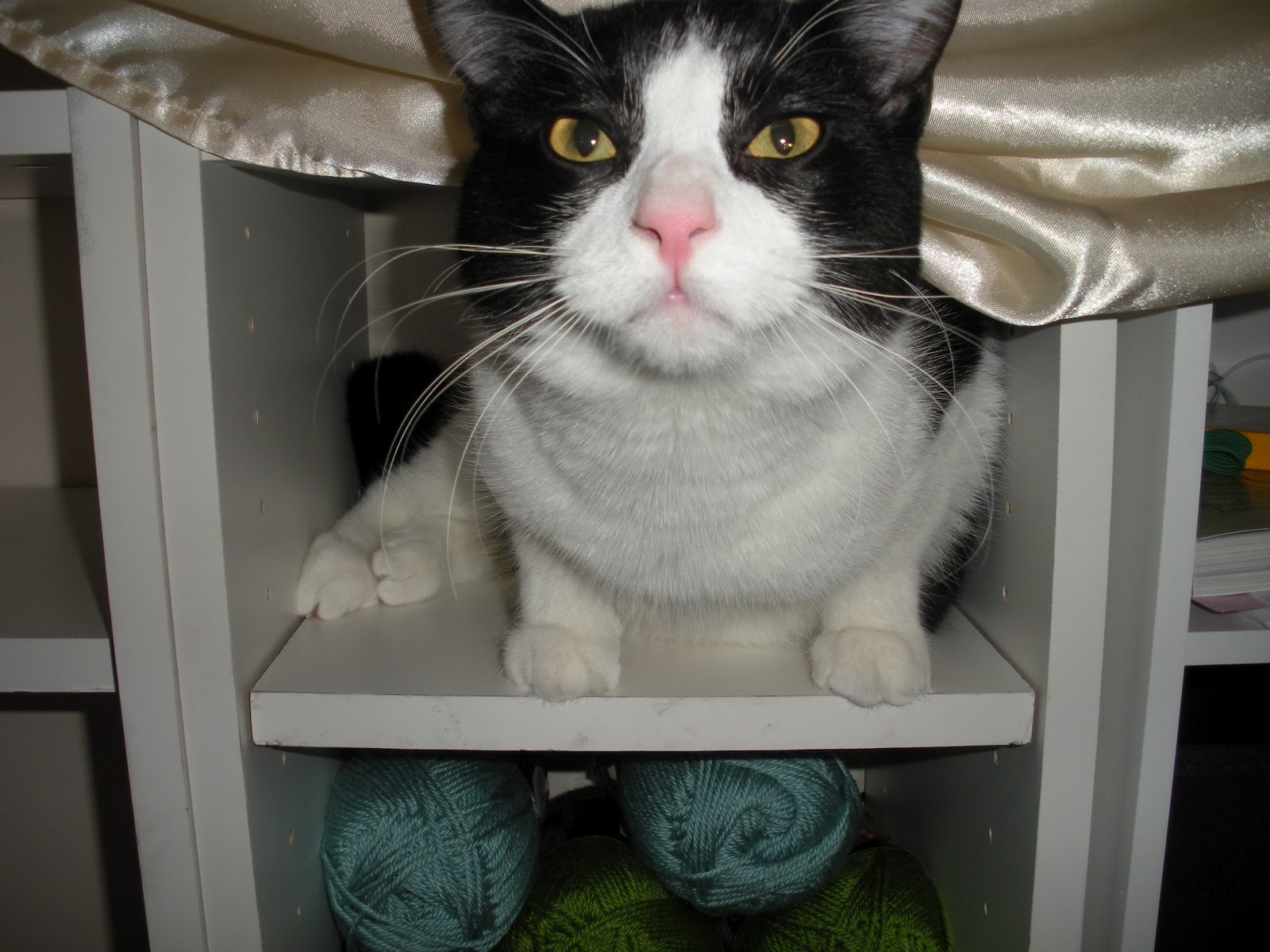
| Hiding with the yarn stash, a favorite past time |
Monday, February 6, 2012
LeRoy
I feel like I would be remiss, writing a blog about living with Tourette Syndrome, if I didn't address the going-ons in LeRoy and my feelings towards it. For those of you living outside of the US (or under a rock in the US), there has been an outbreak of what is being referred to as "Tourette's-like" symptoms in LeRoy, NY. There have been 16 documented cases since August 2011.
Before I go any further, because I have a feeling that some of what I am going to say might touch a nerve, let me say that I have the utmost sympathy for the people of LeRoy, especially the 16 suffering from tics. This isn't something I would wish upon anybody and because I became symptomatic relatively late in life, I can clearly remember dealing with the diagnosis and having to acclimate to school and my environment. I went to a psychiatrist within the first 6 months of my diagnosis who determined my tics were stress related and who proceeded to increase my anti-anxiety medication to the point where I had no real emotions or feelings on the medication. I didn't go to my prom; looking back now it's very easy to say I wouldn't have gone anyway, but truthfully, I could have become a very different person were it not for the Tourette's. I transferred to an independent study school a semester after being diagnosed because sitting for 6+ hours in classes wasn't conducive to me learning. I was terrified to get back up on a horse after being diagnosed, and to this day I still refuse to ride with a crop or whip of any kind because I am still scared of the repercussions of ticcing on a horse with an aid in my hands.
What I'm trying to say is I get it. I get not being able to be in school and I get going to psychiatrists and having them tell you that what you are living with is "stress-related". Hearing that illegitimizes what you are going through. I know what it feels like to not be able to do your "favorite" things. I can empathize with what these teens are going through, and everything I have to say about LeRoy has nothing to do with the teens and everything to do with the media.
The bottom line is that these teens (and one adult) don't have Tourette Syndrome. To even carry that diagnosis, they would have to tic for approximately 6 more months. In addition to that, Tourette's isn't contagious. Tourette Syndrome isn't something you can catch by being around me (though I have heard of Touretters telling stragers they have a terrible communicable disease and to stay away. We all cope with being in public different ways...) It is something that the majority of the time affects prepubescent children; typical age of onset is around 6-8 years old. Furthermore, Tourette's - like many other neurological disorders - affects males 4 times more frequently than it does females. There is no conceivable way that 16 people that don't fit the typical "criteria" for being a Touretter suddenly, and within a couple months of each other, developed true Tourette's.
There are approximately 16 cases of this mystery ailment in LeRoy; 14 adolescent females, one adolescent male, and one adult female. This doesn't correlate with Tourette's.
I may not mind that so much, if phrases like mass hysteria, psychiatric treatment, and conversion disorder weren't being thrown around with Tourette's. What I have isn't treatable with therapy or psychiatric medications. What they are hypothesizing the 16 people in LeRoy have, is treatable by these means. I know that nobody in the media has come out and said that the 16 people in LeRoy have Tourette's; but let's be real here. Tourette's is so heavily stereotyped against that in my opinion comparing it to what is happening in LeRoy will ultimately do more harm than good. I already get told by people that they know somebody who "grew out of Tourette's" and I get asked why I don't take medication and other similar questions a lot. People who hear me tell them there is no known cause or cure typically don't believe me, and I have had people come up to me at later dates and (always in tones of surprise) verify what little there is to know about Tourette's.
When I first heard about this story, my first thought was at least now somebody will pay attention. Now maybe something will be done about looking for a cure or about acceptance. I hoped that the media could use this opportunity to talk about what Tourette's is and what it is like to live with Tourette's and draw parallels to what is happening in LeRoy (and I emailed the Today Show suggesting something along these lines. I am still waiting for a response 2 weeks later.).
No such luck.
Instead they are showing these girls talking about how their lives are ruined, they are showing psychiatrists talking about how it is a psychological disorder, they have Erin Brockovich leading a crusade to find an environmental toxin, and there are articles on the internet blaming Facebook and YouTube for the spread of symptoms.
I'm not an expert in neurological disorders; I wouldn't even call myself an expert in Tourette's, but I do stay up to date with current clinical trials and research, though any new advances are few and far between. What I do know though is that if this is an environmental toxin, why all these cases in such a short time span affecting a very specific group of individuals? The school district has come out saying that there are no toxins in the school that the 15 teens attend. I do know that this isn't Tourette Syndrome; though that doesn't lessen or change what they are going through.
What I also know, is that while it is tough to pin down how many people have full-blown Tourette's like I do (Tourette's with complex verbal and complex motor tics), approximately 1 in 1,000 people in the United States are diagnosed with some degree of Tourette Syndrome. That's just talking about Tourette's, that isn't including Transient Tic Disorder, Chronic Tic Disorder, or Tic Disorder Not Otherwise Specified. If you extrapolate to include those diagnoses, around 1 in 150 people have a tic disorder in the United States. That's a lot of people. I am still waiting for a "cause". I woke up one day just like those in LeRoy and I couldn't control my right hand. About a week later I started head-banging and leg tremoring. There was no catalyst for me, nobody in my family - immediate or extended - has a tic disorder. There was no warning. Nobody has ever offered me an explanation.
I am still waiting for a "cure". There is very little research money going into Tourette's (compared to other disabilities) and all I have been given are recommendations on what to try, medications that are being experimented with in the field of tic disorders, and homeopathic treatment ideas. I have given up hoping for a cure; I will still try medications and I will keep up to date with any breakthroughs, but I am done living with the hope that one day somebody will cure Tourette Syndrome. At least not in my lifetime.
And every other one of those 1 in 1,000 people with Tourette Syndrome are still waiting and hoping for the same things.
I'll openly and plainly admit, I am frustrated with the outpouring of research and support into these 16 cases. I hope and pray that they can find a way to treat or cure those 16 people in LeRoy because I know what a life with severe tics is like. But that doesn't mean that I can't be frustrated at the same time because this opportunity to demystify Tourette's and remove stereotypes isn't being taken. Life with Tourette's is excruciatingly frustrating at times, and this is one of them.
Before I go any further, because I have a feeling that some of what I am going to say might touch a nerve, let me say that I have the utmost sympathy for the people of LeRoy, especially the 16 suffering from tics. This isn't something I would wish upon anybody and because I became symptomatic relatively late in life, I can clearly remember dealing with the diagnosis and having to acclimate to school and my environment. I went to a psychiatrist within the first 6 months of my diagnosis who determined my tics were stress related and who proceeded to increase my anti-anxiety medication to the point where I had no real emotions or feelings on the medication. I didn't go to my prom; looking back now it's very easy to say I wouldn't have gone anyway, but truthfully, I could have become a very different person were it not for the Tourette's. I transferred to an independent study school a semester after being diagnosed because sitting for 6+ hours in classes wasn't conducive to me learning. I was terrified to get back up on a horse after being diagnosed, and to this day I still refuse to ride with a crop or whip of any kind because I am still scared of the repercussions of ticcing on a horse with an aid in my hands.
What I'm trying to say is I get it. I get not being able to be in school and I get going to psychiatrists and having them tell you that what you are living with is "stress-related". Hearing that illegitimizes what you are going through. I know what it feels like to not be able to do your "favorite" things. I can empathize with what these teens are going through, and everything I have to say about LeRoy has nothing to do with the teens and everything to do with the media.
The bottom line is that these teens (and one adult) don't have Tourette Syndrome. To even carry that diagnosis, they would have to tic for approximately 6 more months. In addition to that, Tourette's isn't contagious. Tourette Syndrome isn't something you can catch by being around me (though I have heard of Touretters telling stragers they have a terrible communicable disease and to stay away. We all cope with being in public different ways...) It is something that the majority of the time affects prepubescent children; typical age of onset is around 6-8 years old. Furthermore, Tourette's - like many other neurological disorders - affects males 4 times more frequently than it does females. There is no conceivable way that 16 people that don't fit the typical "criteria" for being a Touretter suddenly, and within a couple months of each other, developed true Tourette's.
There are approximately 16 cases of this mystery ailment in LeRoy; 14 adolescent females, one adolescent male, and one adult female. This doesn't correlate with Tourette's.
I may not mind that so much, if phrases like mass hysteria, psychiatric treatment, and conversion disorder weren't being thrown around with Tourette's. What I have isn't treatable with therapy or psychiatric medications. What they are hypothesizing the 16 people in LeRoy have, is treatable by these means. I know that nobody in the media has come out and said that the 16 people in LeRoy have Tourette's; but let's be real here. Tourette's is so heavily stereotyped against that in my opinion comparing it to what is happening in LeRoy will ultimately do more harm than good. I already get told by people that they know somebody who "grew out of Tourette's" and I get asked why I don't take medication and other similar questions a lot. People who hear me tell them there is no known cause or cure typically don't believe me, and I have had people come up to me at later dates and (always in tones of surprise) verify what little there is to know about Tourette's.
When I first heard about this story, my first thought was at least now somebody will pay attention. Now maybe something will be done about looking for a cure or about acceptance. I hoped that the media could use this opportunity to talk about what Tourette's is and what it is like to live with Tourette's and draw parallels to what is happening in LeRoy (and I emailed the Today Show suggesting something along these lines. I am still waiting for a response 2 weeks later.).
No such luck.
Instead they are showing these girls talking about how their lives are ruined, they are showing psychiatrists talking about how it is a psychological disorder, they have Erin Brockovich leading a crusade to find an environmental toxin, and there are articles on the internet blaming Facebook and YouTube for the spread of symptoms.
I'm not an expert in neurological disorders; I wouldn't even call myself an expert in Tourette's, but I do stay up to date with current clinical trials and research, though any new advances are few and far between. What I do know though is that if this is an environmental toxin, why all these cases in such a short time span affecting a very specific group of individuals? The school district has come out saying that there are no toxins in the school that the 15 teens attend. I do know that this isn't Tourette Syndrome; though that doesn't lessen or change what they are going through.
What I also know, is that while it is tough to pin down how many people have full-blown Tourette's like I do (Tourette's with complex verbal and complex motor tics), approximately 1 in 1,000 people in the United States are diagnosed with some degree of Tourette Syndrome. That's just talking about Tourette's, that isn't including Transient Tic Disorder, Chronic Tic Disorder, or Tic Disorder Not Otherwise Specified. If you extrapolate to include those diagnoses, around 1 in 150 people have a tic disorder in the United States. That's a lot of people. I am still waiting for a "cause". I woke up one day just like those in LeRoy and I couldn't control my right hand. About a week later I started head-banging and leg tremoring. There was no catalyst for me, nobody in my family - immediate or extended - has a tic disorder. There was no warning. Nobody has ever offered me an explanation.
I am still waiting for a "cure". There is very little research money going into Tourette's (compared to other disabilities) and all I have been given are recommendations on what to try, medications that are being experimented with in the field of tic disorders, and homeopathic treatment ideas. I have given up hoping for a cure; I will still try medications and I will keep up to date with any breakthroughs, but I am done living with the hope that one day somebody will cure Tourette Syndrome. At least not in my lifetime.
And every other one of those 1 in 1,000 people with Tourette Syndrome are still waiting and hoping for the same things.
I'll openly and plainly admit, I am frustrated with the outpouring of research and support into these 16 cases. I hope and pray that they can find a way to treat or cure those 16 people in LeRoy because I know what a life with severe tics is like. But that doesn't mean that I can't be frustrated at the same time because this opportunity to demystify Tourette's and remove stereotypes isn't being taken. Life with Tourette's is excruciatingly frustrating at times, and this is one of them.
"The death of one man is a tragedy. The death of a million is a statistic."
~ ~ ~ ~ ~
~ ~ ~ ~ ~
Update: Somebody with some actual sense debunks the myths that these tics were caused by something other than conversion disorder here.
Wednesday, February 1, 2012
"What's wrong with you?" and other amusing conversations
"Can you drive?"
"I don't know if I feel comfortable with you on the road..."
Most people are "polite" enough not to say anything within earshot. Most of the time they just stare. Blatantly. Unlike a lot of Touretters I don't have a snarky response I resort to; I just stare people down until they feel embarrassed and look away.
"Are you okay?"
Usually followed by, "Are you sure you're okay?"
My chiropractor upon first meeting me and after staring at my skull for a while, "Does it hurt when I do this? Huh... you have abnormal skull plate movement."
He pauses with a stumped look on his face; I offer up, "Well, I've been hitting myself in the forehead all day for the past week or so, could that do it?"
"...So it's like a sneak attack from yourself?"
"What's wrong with you?"
"So, does this mean you are going to swear in my class?" (a professor)
"What was that noise?" (Who me? A squeak? Didn't hear a thing...)
On an airplane, after 2 hours of silence, as soon as the seatbelt light is off and I jump up the people sitting next to me strike up this conversation (thinking I am out of earshot).
"What was wrong with her?"
"I don't know... I think it's called Tourette's or something..."
"Ma'am, do you need help?" (TSA agent - this was the first positive interaction I've ever had with a TSA agent)
"She's just using it as an excuse to not work hard."
"My nephew/neighbor/some kid I used to know had that; they grew out of it." (Yeah, thanks... because I never will.)
"It must be cool having Tourette's; you can swear or hit people whenever you want and not get in trouble for it." (Yeah, except not so much...)
And the best for last, a conversation with a freshman after my presentation...
Really quiet... "Have you ever... you know... smoked pot?"
I (nicely) explain that no, I never have, but there are some Touretters who do. It's just not a choice I am going to make.
"I respect that..." He thinks for another minute or so. "You know... If I had something like that, and meds weren't working, I think I might try it."
And by the looks of it, I think he'd already done so :)
"I don't know if I feel comfortable with you on the road..."
Most people are "polite" enough not to say anything within earshot. Most of the time they just stare. Blatantly. Unlike a lot of Touretters I don't have a snarky response I resort to; I just stare people down until they feel embarrassed and look away.
"Are you okay?"
Usually followed by, "Are you sure you're okay?"
My chiropractor upon first meeting me and after staring at my skull for a while, "Does it hurt when I do this? Huh... you have abnormal skull plate movement."
He pauses with a stumped look on his face; I offer up, "Well, I've been hitting myself in the forehead all day for the past week or so, could that do it?"
"...So it's like a sneak attack from yourself?"
"What's wrong with you?"
"So, does this mean you are going to swear in my class?" (a professor)
"What was that noise?" (Who me? A squeak? Didn't hear a thing...)
On an airplane, after 2 hours of silence, as soon as the seatbelt light is off and I jump up the people sitting next to me strike up this conversation (thinking I am out of earshot).
"What was wrong with her?"
"I don't know... I think it's called Tourette's or something..."
"Ma'am, do you need help?" (TSA agent - this was the first positive interaction I've ever had with a TSA agent)
"She's just using it as an excuse to not work hard."
"My nephew/neighbor/some kid I used to know had that; they grew out of it." (Yeah, thanks... because I never will.)
"It must be cool having Tourette's; you can swear or hit people whenever you want and not get in trouble for it." (Yeah, except not so much...)
And the best for last, a conversation with a freshman after my presentation...
Really quiet... "Have you ever... you know... smoked pot?"
I (nicely) explain that no, I never have, but there are some Touretters who do. It's just not a choice I am going to make.
"I respect that..." He thinks for another minute or so. "You know... If I had something like that, and meds weren't working, I think I might try it."
And by the looks of it, I think he'd already done so :)
Subscribe to:
Posts (Atom)